


Technical SEO
We make sure your site is lightning-fast, has all the right code, and is Google-ready.
SEO isn’t optional it’s essential. We help businesses increase visibility, attract qualified traffic, and generate more enquiries through proven SEO strategies.
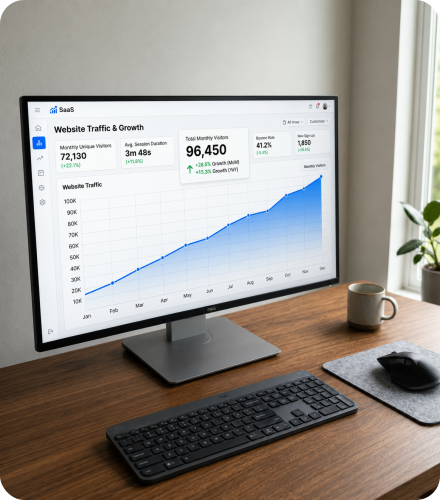





We don’t believe in one-size-fits-all SEO. Every business is different – which is why we take the time to understand your goals, market, and competitors before launching any campaign. Our award winning process and SEO system includes:
We make sure your site is lightning-fast, has all the right code, and is Google-ready.

We target high-value keywords that connect your business with the right customers.

We optimise every on-page element for maximum SEO performance.

Clear, jargon-free updates showing progress, rankings, traffic, conversions, and what we’re doing next.

We build high-quality backlinks that strengthen your website’s authority and improve Google rankings.

We produce reverse-engineered search-optimised content that attracts traffic and builds trust.
Promote Online was built on honesty and transparency. Too many other digital marketing agencies focus on their own growth rather than their clients, but we wanted to change that. Today, our SEO agency works closely with clients, explaining each step of the process in plain English. Whether you’re a small local business or a growing eCommerce brand, you’ll always know what we’re doing and why.

We go through your site and recommend where improvements can be made.
We work with you to find out which Google search phrases you want and should be ranking for.
We can update your website to ensure it is as optimised as possible for Google.

We monitor every account and campaign every day to make the necessary adjustments.

Linking to high authoritative domains is key in improving your rankings and we help you build these.
Giving you full transparency on how your keywords are ranking and how things are going.
Our clients come to us for practical advice, proactive management and marketing that makes a measurable difference. From stronger enquiry levels to clearer reporting and better use of budget, the focus is always on helping the business move forward.
“Have Been Using Promote Online For A While Now And Couldn't Recommend Enough.”
Everything Is Transparent And Easy; Some Marketing Companies Promise Results And Fail To Deliver, But Promote Online Don't. Curtis In Particular, Who We Have Dealt With For A Long Time, Is Brilliant And Has Always Been Helpful.

“We've been working with Promote Online for some time now and have been really impressed with the results.”
Our visibility on Google has noticeably improved, which is making a real difference to our business. The team has been great to collaborate with – responsive, knowledgeable, and proactive in helping us develop and improve our website. It's been a smooth and productive partnership, and we’re looking forward to continuing to work together. Highly recommended!

“Promote online have been responsible for growing our online presence for a number of years”
and have proved proactive and innovative at developing it to the extent that we are at a point where we cannot handle much more traffic and keep the levels of service we aim to provide. The staff at Promote online are genuinely interested in developing the business with us and it's clear that it's not just a job for them.


Finding the right terms, matched to the right pages.

Better titles and descriptions, better click-through.

Faster pages, optimised images, fixed technical issues.
Content written to rank and to convert.

Earning links from trusted, relevant sites.

Getting your brand covered by real publications.
Content that builds authority over time.
A full health check of your site's SEO.

Showing up when local customers search nearby.
Search engine optimisation is the process of improving your website so that it can be discovered, understood and ranked by search engines for relevant searches.
However, effective SEO is not simply about increasing traffic or placing a few keywords on a page. It involves aligning your website’s technical configuration, content, architecture, authority and user experience with the way potential customers search.
At Promote Online, we connect SEO activity to commercial objectives. This means identifying the products, services, locations and search terms most likely to generate qualified enquiries or sales, rather than chasing high-volume keywords with little purchasing intent.
We then improve your website’s ability to appear for those searches, guide visitors towards the right information and accurately measure the resulting conversions. The objective is not traffic for traffic’s sake. It is sustainable organic visibility that contributes to leads, sales and long-term revenue growth.
Every strategy is tailored to the website, market and commercial opportunity, but a comprehensive campaign may include:
We prioritise activity according to potential impact. A website with serious indexing problems may require technical work before significant content investment, while an established site with strong foundations may benefit more from content expansion, internal linking and authority building.
We begin by establishing what commercial success looks like for your business. This may include increasing qualified enquiries, generating e-commerce sales, entering new geographical areas, improving visibility for higher-value services or reducing reliance on paid advertising.
We then analyse your website, organic performance, competitors, search demand and technical condition. This helps us understand the difference between where the website is now and where it needs to be
The strategy is developed around several connected areas:
Rather than applying the same checklist to every business, we identify the specific constraints limiting your organic growth and prioritise the work most likely to remove them.
Keyword selection is based on far more than monthly search volume. A term can attract thousands of searches while producing very few relevant customers.
We assess factors including:
• Search intent
• Commercial relevance
• Geographic relevance
• Competition levels
• Existing rankings
• Search-result composition
• Conversion potential
• Customer terminology
• Average order or enquiry value
• Seasonality
• The strength of competing websites
• Whether the query is informational, comparative or transactional
We also analyse groups of semantically related searches rather than treating every slight keyword variation as a separate target.
Each priority keyword cluster is mapped to the most appropriate existing or proposed page. This reduces internal competition between pages and creates a clearer relationship between the search query, the landing page and the action we want the visitor to take.
Search intent describes the underlying objective behind a search.
For example, someone searching for “what is technical SEO?” is likely looking for information. Someone searching for “technical SEO agency Bristol” is much closer to choosing a provider. Although both searches relate to the same subject, they require very different pages and content.
Search intent is commonly divided into several broad categories:
• Informational: The user wants an answer or explanation.
• Commercial investigation: The user is comparing options.
• Transactional: The user is ready to enquire or purchase.
• Navigational: The user is looking for a particular brand or website.
• Local: The user wants a nearby provider, location or service.
We examine the current search results to understand what Google is rewarding for each query. We then create or improve the page so that its format, depth, purpose and call to action match the likely needs of the searcher.
A technical SEO audit investigates whether search engines can efficiently discover, crawl, render, interpret and index the correct parts of your website.
Depending on the site, our analysis may cover:
• HTTP status codes
• Redirect chains and loops
• Broken internal links
• XML sitemaps
• Robots.txt directives
• Robots meta directives
• Canonical tags
• Duplicate URLs
• Index bloat
• Orphaned pages
• Crawl depth
• Internal linking
• Pagination
• Parameter URLs
• Faceted navigation
• Mobile rendering
• JavaScript-rendered content
• Structured data
• International targeting
• Page speed
• Core Web Vitals
• Image delivery
• Server configuration
• Website security
• Log-file data
• Search Console indexing reports
The audit does not simply produce a list of warnings from an automated tool. We evaluate whether each issue is genuinely affecting search visibility, prioritise it according to severity and provide an implementation plan.
Page speed and usability form part of the wider page experience, but improving a performance score alone will not compensate for weak content, poor targeting or low authority.
Core Web Vitals assess real-world aspects of user experience, including:
We distinguish between laboratory data, which is collected in a controlled test, and field data, which reflects the experience of real users.
Optimisation may involve improving server response times, image delivery, caching, script execution, font loading, content delivery networks, third-party tags and above-the-fold resource prioritisation.
The commercial benefit is also important. A faster, more stable website can reduce frustration and make it easier for visitors to enquire or purchase.
On-page SEO improves the relevance, clarity and search presentation of an individual page.
This may include optimising:
We do not optimise pages by repeatedly inserting an exact-match keyword. Modern on-page SEO requires a clear understanding of the subject, search intent and information needed for someone to make a decision.
The page should communicate its purpose quickly, answer relevant questions, demonstrate genuine expertise and provide a logical next step. Search optimisation and conversion optimisation should support each other rather than being treated as separate disciplines.
We begin with the customer and commercial purpose of the page, not simply a target word count.
Our research may include:
We then establish what the content must accomplish. A service page should explain the service, differentiate the provider, address objections and encourage an enquiry. A guide may need to educate the reader, demonstrate expertise and direct them towards the next relevant stage.
We avoid producing generic content that merely paraphrases competing websites. Wherever possible, we incorporate original processes, examples, data, perspectives, images, case studies and practical experience.
Content should earn its place on the website by supporting visibility, trust, conversion or customer understanding
Search is becoming more conversational, but the underlying need for accessible, well-structured and trustworthy information remains.
Google’s generative search features use information retrieved from the search index. Therefore, the same foundations remain important: crawlability, indexation, content quality, clear page structure, authority and relevance.
We strengthen the likelihood of your information being discovered and understood by:
We do not treat “GEO” or “AEO” as a shortcut that replaces SEO. Generative visibility should form part of a broader search strategy rather than being sold as an isolated technical trick.
Yes, where authority development is required, but we focus on the relevance and legitimacy of links rather than purchasing large quantities of low-quality placements.
A backlink is a link from another website to yours. Links can help search engines discover content and evaluate how websites are referenced across the web.
Authority-building activity may include:
• Digital PR
• Expert commentary
• Industry publications
• Supplier and partner links
• Relevant business directories
• Local citations
• Resource outreach
• Original research
• Linkable assets
• Case-study collaboration
• Unlinked brand-mention reclamation
• Competitor link-gap analysis
We do not judge a link solely by a third-party authority score. We assess the website’s relevance, editorial standards, traffic, indexing, content quality, placement and overall risk.
The objective is to build a credible backlink profile that reflects real relationships, expertise and reputation.
Yes. Local SEO combines website optimisation, location relevance, Google Business Profile management, authority and consistency across the wider web.
A local strategy may include:
We do not recommend creating hundreds of near-identical town pages with only the place name changed. Location pages need a genuine purpose and should contain information relevant to customers in that area.
Where a business serves a broad region, we create a structure that reflects operational reality and prioritises the locations with the strongest commercial opportunity.
Not necessarily, but physical proximity can be particularly important for map-based results.
A service-area business may still build organic visibility in locations where it does not have an office, provided it genuinely serves those areas and has useful, relevant website content.
However, creating virtual offices, false addresses or duplicate Google Business Profiles can create compliance and suspension risks.
We separate two opportunities:
We develop a realistic strategy based on your genuine locations, service coverage, competition and available evidence, such as local projects, customer reviews and area-specific experience.
E-commerce websites often have far more URLs and more complex technical requirements.
An e-commerce strategy may need to address:
Category pages often target broader commercial searches, while product pages capture specific intent. Supporting guides can answer research-stage questions and link users towards suitable products.
We also consider profitability, stock levels, average order value and conversion data. Ranking a low-margin product is not necessarily more valuable than improving visibility for a commercially important category.
Yes, although a new domain usually begins without the historical signals, backlinks, indexed content and search visibility of an established website.
Early work typically focuses on:
New websites should not attempt to target every possible keyword immediately. We prioritise the pages most closely connected to revenue and create a foundation that can expand over time.
Progress may initially be less predictable because search engines need to discover, process and evaluate the new website. Strong planning at the beginning can prevent expensive structural problems and reduce the need to rebuild large sections later.
It can. A redesign may improve SEO, but it can also cause substantial losses if search-critical elements are removed or changed without a migration plan.
Common redesign risks include:
We compare the existing and proposed websites before launch, identify high-value URLs and create a detailed redirect map.
Following launch, we monitor server responses, crawling, indexation, rankings, traffic and conversions. Some fluctuation is normal, but careful planning significantly reduces avoidable risk.
We measure SEO through several layers rather than relying on a single metric.
Visibility metrics may include:
Engagement and acquisition metrics may include:
Commercial metrics may include:
Rankings and traffic are useful indicators, but the most valuable measurement is whether organic search contributes to genuine business growth.
Where possible, we connect analytics, call tracking, forms and CRM data so that we can assess lead quality as well as lead quantity.
Yes, provided the appropriate tracking and business processes are available.
Website activity can be measured through GA4 and Google Tag Manager, while call-tracking software can help attribute telephone enquiries to their source.
For businesses with longer sales cycles, we may recommend connecting website leads to a CRM.
This makes it possible to distinguish between:
This is particularly important where different services have very different commercial values.
No attribution system is perfect. Customers may use several devices, return through another channel or call after seeing the business elsewhere. We therefore combine platform data with CRM evidence, call recordings and wider commercial trends to build a more realistic picture of SEO performance.
There is no universal timescale because every website begins from a different position.
Factors affecting progress include:
Technical corrections can sometimes produce relatively quick improvements, particularly where a website has been blocked or misconfigured. Competitive commercial rankings usually require sustained work across content, technical SEO and authority.
We establish realistic milestones based on the starting data. Early indicators may include improved crawling, indexation, impressions and ranking movement. Traffic, enquiries and revenue often follow as visibility reaches stronger positions.
SEO should be viewed as a compounding growth channel rather than a one-off switch.
Where an eligible Promote Online campaign includes a defined ranking guarantee, the specific qualifying keywords, starting conditions, timescale and obligations will be clearly documented before the campaign begins.
No responsible agency can control Google or guarantee that every keyword will retain a fixed position indefinitely. Search results change continuously and are influenced by competition, location, website changes and search-engine updates.
Our guarantee is therefore tied to an agreed campaign scope rather than an open-ended promise covering every term a business may wish to rank for.
We combine this with clear reporting, technical work, content development and ongoing optimisation. More importantly, we remain focused on whether increased visibility is producing qualified opportunities for the business—not simply whether an isolated keyword briefly reaches a particular position.
Normally, yes. The exact access required depends on the campaign, but it may include:
Access allows us to properly diagnose issues, implement agreed changes and measure results.
We request only the level of access required for the work. Where a business has an internal developer or IT provider, we can supply recommendations and collaborate with them instead of making direct server-level changes.
Access should be provided through individual user accounts wherever possible rather than sharing master passwords.
This depends on the website, campaign scope and access available.
Many CMS-based improvements can be implemented directly by our team. More complex changes involving server configuration, custom code, JavaScript frameworks, database behaviour or core templates may require your website developer, but we do have in house developers who can implement these for you if your developer is unable to.
Where another developer is involved, we provide clear recommendations explaining:
We then review the completed work to confirm that it has resolved the original problem and has not introduced new issues.
A technical recommendation is only valuable when it is correctly implemented. For that reason, we track development actions rather than allowing an audit to become a forgotten list of theoretical improvements.
Yes. Your industry expertise is a valuable part of the content process.
We research the search landscape, structure the page, optimise it and write it with organic performance in mind. However, your team should confirm that technical statements, services, processes, prices, geographical coverage and regulatory details are accurate.
Timely approval is important. Content that remains in draft form cannot be crawled, indexed or generate enquiries.
We aim to make approval straightforward by presenting content clearly and incorporating your feedback. Where several stakeholders are involved, appointing one primary approver can prevent contradictory revisions and lengthy delays.
The strongest content usually combines our search and conversion expertise with the client’s first-hand knowledge.
Content should be reviewed when it becomes outdated, loses performance, no longer reflects the service or can be improved to satisfy search intent more effectively.
The appropriate frequency varies. A legal or technical guide may require regular factual review, while an evergreen service page may remain accurate for longer.
We may update content when:
Updating does not mean changing a few words to make a page appear “fresh”. Revisions should add genuine value, correct inaccuracies, improve clarity or strengthen the page’s commercial purpose.
Yes. SEO and paid search can provide valuable data for each other.
Google Ads can quickly reveal:
SEO can then build longer-term visibility around validated opportunities.
Organic search data can also identify new paid-search themes, while combined visibility may increase the likelihood of a potential customer choosing your business.
The two channels should not be measured identically. Google Ads purchases immediate visibility, while SEO develops an owned organic asset over time. Used together, they can reduce reliance on a single acquisition source and provide a more complete view of customer search behaviour.
The website improvements, approved content, internal links and technical changes implemented on your website remain part of your website.
You should also retain ownership of your business accounts, including Google Analytics, Search Console, Google Business Profile and Tag Manager. Our team should be added as authorised users rather than becoming the sole owner of your data.
Some third-party tools used for reporting, crawling or keyword monitoring may operate under our agency licences. Access to those particular systems may end when the service ends, but your core website and business accounts remain yours.
We believe SEO should strengthen a business’s digital assets rather than create unnecessary dependence on an agency.
The exact order depends on the findings, but early activity commonly includes:
We distinguish between foundational work and ongoing growth activity.
Foundational work helps search engines access, understand and correctly index the website. Ongoing work expands relevant content, strengthens authority, improves conversion opportunities and responds to performance data.
We explain the priorities so you understand why particular work is being completed and how it supports the wider strategy.
Our reporting is designed to show progress, commercial performance and the actions being taken—not simply present a collection of disconnected charts.
Depending on the campaign, reporting may include:
We also explain the context behind the figures. For example, an increase in traffic is less meaningful if it comes from irrelevant informational searches, while a smaller rise in highly commercial traffic may be extremely valuable.
Our strategy is reviewed as performance data, competition and search behaviour change.
We treat SEO as a commercial growth strategy rather than a checklist of isolated technical tasks.
Our work connects:
We prioritise the searches and landing pages most closely connected to your business objectives. We also explain what we are doing, why it matters and how performance is being measured.
SEO contains technical complexity, but clients should not be kept in the dark behind unexplained terminology or vanity metrics.
The goal is to create a stronger website, a clearer customer journey and a sustainable source of qualified organic visibility.
Yes. Domain migrations require technical preparation, accurate implementation and close post-launch monitoring.
Our migration process may include:
Redirecting every old URL to the homepage is rarely appropriate. Redirects should preserve relevance and provide users with the closest equivalent destination.
A migration cannot guarantee zero volatility, but a controlled process protects far more organic value than launching first and attempting to repair the damage afterwards.
There are many possible reasons. A page may be blocked, duplicated, redirected, canonicalised elsewhere, inaccessible to crawlers or judged unsuitable for indexing.
Common causes include:
Google Search Console may provide a broad reason, but further investigation is often required to identify the actual cause.
We compare Search Console information with crawl data, page source, rendered HTML, sitemap configuration, internal links and server responses. The objective is not necessarily to index every URL. It is to ensure that the pages capable of generating organic value are accessible, distinctive and correctly signalled.
Crawl budget broadly refers to the amount of crawling a search engine is willing and able to perform on a website over a period of time.
For a small service-based website, crawl budget is rarely the main SEO constraint. For large e-commerce sites, marketplaces, publishers or websites generating thousands of filtered and parameter-based URLs, inefficient crawling can become more significant.
Problems arise when search engines repeatedly crawl low-value or duplicate URLs while important pages are discovered or refreshed less efficiently.
We may improve crawl efficiency by:
The goal is to create a clear, efficient website structure—not to block crawling indiscriminately.
A canonical tag indicates which URL should be treated as the preferred version when multiple URLs contain identical or very similar content.
Duplicate URLs can be created by tracking parameters, filters, print versions, product variations, HTTP and HTTPS versions, trailing slashes or alternative category routes.
Canonical tags help consolidate indexing and ranking signals, but they are not an absolute instruction. Search engines may choose a different canonical when other signals conflict.
We review canonical tags alongside:
A canonical tag should not be used to conceal poor website architecture. Wherever possible, all technical signals should consistently point towards the same preferred URL.
Yes. JavaScript websites can perform extremely well in organic search, but they require careful implementation.
Search engines may process JavaScript content differently from traditional server-delivered HTML. Problems can occur when essential text, internal links, metadata or canonical tags are only available after complex client-side rendering.
We may assess:
Where appropriate, we work with developers to make critical SEO content available within the initial HTML response or through a reliable rendering solution. The best approach depends on the framework, hosting setup and website functionality.
These are separate stages of the search process.
Crawling occurs when a search engine requests a URL and discovers the page’s resources, links and content.
Rendering is the process of constructing the page, including content or links that may depend on JavaScript execution.
Indexing occurs when the search engine processes the page and considers storing its content within its searchable index.
A page can be crawled without being indexed. It can also be indexed incorrectly if important content is hidden during rendering, canonical signals are conflicting or the page is considered duplicative or insufficiently valuable.
Our technical work examines the complete process. We look beyond whether a page merely exists and determine whether search engines can access the intended version, understand its purpose and associate it with the correct search topics.
Index bloat occurs when a search engine indexes large numbers of unnecessary, duplicate or low-value URLs.
Examples may include:
Index bloat can make it harder for search engines to understand which pages are important. It may also dilute internal linking signals, create keyword cannibalisation and waste crawling resources.
We analyse the relationship between the number of crawlable URLs, indexed URLs and commercially valuable landing pages. We then decide whether affected URLs should be improved, consolidated, redirected, canonicalised, removed or excluded from indexing.
The objective is not to make the website as small as possible. It is to ensure that each indexable page has a clear purpose and provides distinct value.
Website architecture determines how pages are organised, connected and prioritised.
A strong architecture enables users and search engines to move logically from broad topics to more specific services, products, locations or resources. It also helps distribute internal authority towards commercially important pages.
We may review:
We avoid forcing every target keyword into the main navigation. Instead, we create a scalable structure that reflects your services and customer journeys.
For larger websites, architecture planning is particularly important. Adding content without a clear structure can lead to duplication, cannibalisation and a website that becomes increasingly difficult to manage.
Internal links connect pages within your own website. They help visitors navigate related information and help search engines discover pages, understand relationships and evaluate relative importance.
We use internal linking to support both relevance and authority.
For example, an educational article may link naturally to a relevant service page. A main category may link to its subcategories, while supporting pages can reinforce a central topic or service.
Our analysis may consider:
Internal linking should be useful and natural. Adding hundreds of repetitive keyword-rich links can create a poor experience and is not a substitute for thoughtful architecture.
Keyword cannibalisation occurs when several pages compete for substantially the same search intent.
This does not mean that a website can only mention a topic once. Multiple pages can rank for related searches when they serve distinct purposes. The problem arises when search engines struggle to identify which page is the strongest or most appropriate result.
Symptoms may include:
We investigate the query, page purpose, content overlap, internal linking, canonical signals and backlink profiles.
The solution may involve consolidating pages, changing their target intent, improving one primary page, redirecting obsolete URLs or building a clearer internal linking hierarchy.
Topical authority describes the depth, credibility and connectedness of a website’s coverage within a particular subject area.
It is not achieved by publishing hundreds of loosely related articles. A website needs a coherent group of useful pages that collectively demonstrate understanding of the customer’s questions, problems, services and decision-making process.
A topical strategy may include:
These pages should be connected through logical internal linking and avoid unnecessary overlap.
We focus on building coverage around commercially relevant areas. A business does not need to publish content about every possible subject in its industry. It needs to become a particularly strong and useful resource within the areas it genuinely serves.
Structured data is machine-readable code that describes the meaning of information on a page.
For example, it can help identify a business, product, service, article, event, review, breadcrumb trail or frequently asked question.
Correct structured data can help search engines interpret page content and may make certain pages eligible for enhanced search features. However, it does not guarantee a rich result and should accurately reflect information that is genuinely available to users on the page.
Our work may include reviewing or implementing appropriate Schema.org types through JSON-LD. We also check for:
Structured data supports understanding, but it cannot compensate for low-quality content or poor technical foundations.
“Toxic backlink” is a broad third-party term rather than a label automatically assigned by Google.
Some links may be manipulative, spam-generated or part of an artificial network. However, not every unusual or low-authority link is dangerous. Websites naturally attract irrelevant links, scraper links and automated references over time.
We examine patterns rather than panicking over individual links. Potential concerns may include:
In many cases, search engines can ignore obvious spam. A disavow file should not be uploaded casually, as incorrectly disavowing legitimate links may remove useful signals.
We assess backlink risk carefully and recommend action only where there is a defensible reason to do so.
Google Search Console and GA4 measure different parts of the user journey.
Search Console reports activity within Google Search, including impressions, clicks, queries and average positions. GA4 measures activity after users arrive on the website and records sessions, events and conversions according to its own attribution and privacy rules.
The figures may differ because of:
We do not expect the platforms to match exactly. Instead, we use each one for its intended purpose and analyse trends across multiple sources.
Rankings are dynamic. Search engines continually crawl websites, reassess content, process links, test result formats and update their ranking systems.
Movement may be caused by:
We avoid overreacting to a single daily movement. Instead, we examine trends across groups of keywords, landing pages, locations and time periods.
A meaningful decline requires investigation, but not every fluctuation indicates a penalty or technical problem. The context and duration of the change are critical.
Often, yes, although the amount of recoverable visibility depends on what changed, how long ago the migration occurred and whether the original URLs or content can still be reconstructed.
We may investigate:
We compare historical and current data wherever it is available, including analytics, Search Console, backlink tools, previous sitemaps and archived URL lists.
Recovery may involve restoring important pages, correcting redirect maps, reclaiming backlinks, rebuilding internal links and improving content. The sooner migration problems are identified, the easier it is to diagnose what was lost.
The use of an AI tool does not automatically make content good or bad. The important questions are whether the content is accurate, useful, distinctive and created for a genuine audience.
Problems arise when businesses publish large volumes of unreviewed content that adds little original value. This can create factual errors, repetition, weak brand language, duplicated ideas and pages that exist primarily to manipulate search visibility.
Where AI assists a content workflow, we still apply human research, editing, fact-checking, brand understanding and strategic judgement.
Strong content should include elements a generic model cannot reliably invent, such as:
Our priority is not whether a draft began with a human or a tool. It is whether the finished page deserves to be found, trusted and acted upon.


